Mary’s Nature Note Books

October 17, 2009 Mary Greg Comments Off on Mary’s Nature Note Books

We had a fantastically productive day at Sheffield. The nature diaries are fabulous, not only revealing Mary’s accomplished drawing skills but also a keen eye for detail and a diligence and commitment to collecting that is abundantly evident through her Bygones collection (I wish I could post some images but we still need to receive copyright permission). Here she is collecting information about the flora and fauna of the Westmill area in Hertfordshire, but particularly in and around the garden at Coles, the family residence.
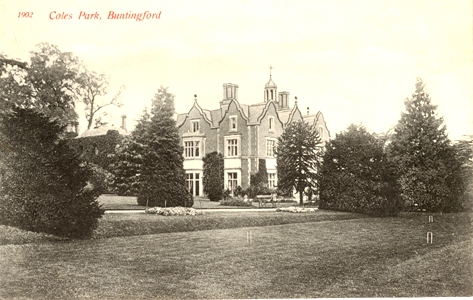
Coles residence, the site of the nature diaries

Coles residence, the main site of the nature diaries

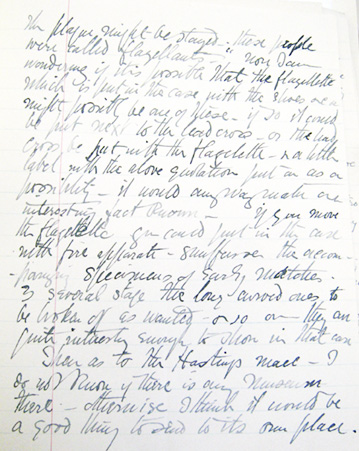
Dating from the early 1900’s every page is a delight with a number of comprehensive drawings in a variety of media (she was very good at bugs and spiders) and handwritten notes which are both analytically incisive and heart felt. Writing of these books to the Guild of St George (to whom she donated the note books in 1940) she says “..I have two nature note books done at various times… They are…amateurish, I had no lessons. I tried to paint little things which I thought of interest or beauty – this Ruskin had taught me to aim at.…”. The drawings are very much in the Ruskin tradition.

One of my favourite inclusions is a series of rubbings taken from a rough pole across a stile at Church Stretton. These show the galleries produced by the female beetles and larvae of scolytid beetles and demonstrate her attention to detail and genuine curiosity for the world around her. The books are also full of little anecdotes such as the mole that Hazel mentions “…found in the potting shed. Sorry to say (I/we?) killed it fearing its ravages in the garden“. But she drew it afterwards so all not lost then! She sometimes tried to save things too, like the baby chaffinch that fell out of the nest whilst she was taking tea, she gave it a meal of chopped egg!

Perhaps the notebooks also reveal the origin of one of the objects in the Bygones collection! In November 1917 she wrote “… I’ve found a group of the smallest funghi I have ever seen. I looked at a piece of this plank and looked at them through a microscope…”. There is a microscope in one of the cupboards at Queen’s Park. I wonder if it was the one she used?

Also stuck into one of the books is a wonderful photograph showing “the artist at work“. Mary is sat at a table full of drawing equipment in the garden at Coles (if only the microscope had been there!).

These notebooks are packed full of the most delightful, charming and meticulous information and deserve to be published in their own right. They are certainly as good if not better than anything else published of this ilk. One is currently on display at the Graves Art Gallery in Sheffield. If you get the chance go and have a look, you won’t be disappointed! Sharon
Spoons

September 27, 2009 Artist Responses 3 Comments
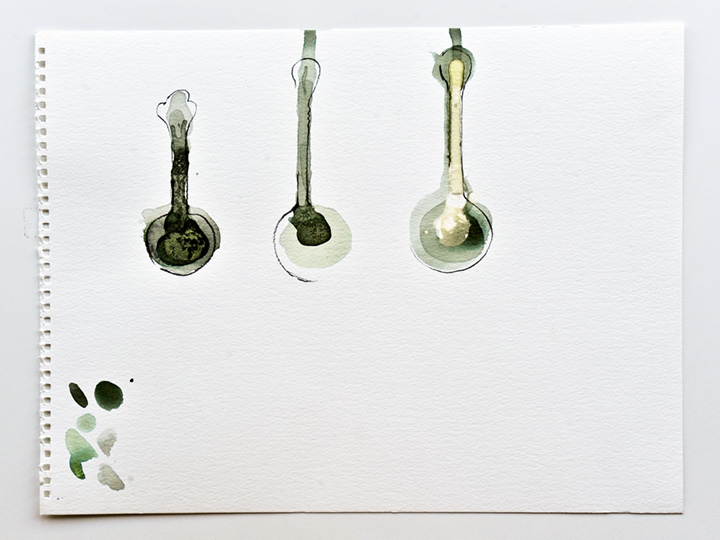
Poured spoon, layered inks, charcoal pencil

Poured spoon, layered inks, charcoal pencil

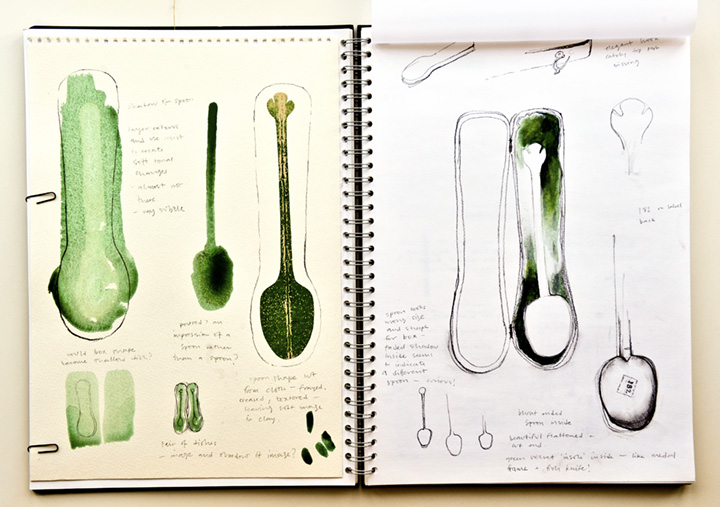
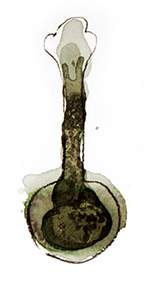
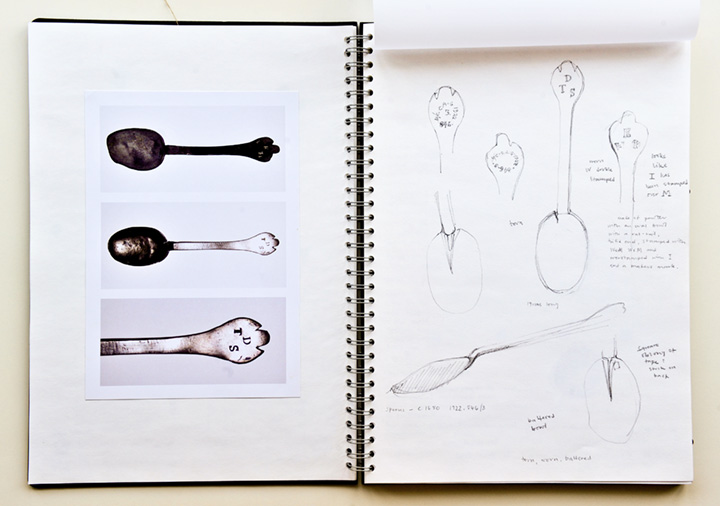
I keep coming back to Mary’s spoons.  I have been drawing them in different ways, observing forms, details, characteristics and noticing things as a consequence.  The fig-shaped bowls of the Apostle spoons, different shaped finials and spoon ends, stamped initials, twisted stems, worn edges, shadows left in boxes.  Difficult to capture the essence of these through drawing!

Observation drawings of trefid spoons

Observation drawings of trefid spoons

Apostle spoons and first ink pourings

Apostle spoons and first ink pourings

Sketchbook drawings exploring spoon and spoon box

Sketchbook drawings exploring spoon and spoon box

The worn spoon edges were particularly tricky.  Pencil just wasn’t quite right so I began to explore other media.  The edge looked like the edge that is made by a liquid – full of tension yet fragile and vulnerable (have a good look at a puddle or a drip of tea!).  How to represent that in a drawing?  I liked the notion of drawing with a liquid.  I have always enjoyed the marks created as a liquid dries.  I began to make puddles of ink, tipping these away to form the shaft of the spoon, discovering that the density and movement of the colour could be controlled through careful angling and supporting when drying.  Layering thin stains of colour created further subtleties and nuances and working over the pourings when dry provided additional detail.  I am beginning to see ways in which these qualities might be translated into clay through slips and glaze, pouring and layering, marking and stamping.  Making the drawings, drives the testing, the testing feeds the making….   Sharon

Spoon pourings, layered ink, resist, charcoal pencil

Spoon pourings, layered ink, resist, charcoal pencil

Guardian Research Profiles

September 24, 2009 Developments Comments Off on Guardian Research Profiles

The Guardian is launching a new regular feature highlighting interesting university research projects. Each week they will profile a researcher / research team and their project. They are asking for examples of any unusual, ground-breaking or exciting research.

Mary, Mary is all of these!  What do you think?  It would be a fab way of launching the blog / website!!  Sharon

Visitor Numbers

September 23, 2009 Mary Greg 3 Comments

I’ve been going through the file of stuff that Melanie compiled for us and came across the visitor numbers again.  Did Mary have any objects in or connection with Heaton Hall prior to 1922?  It’s just that in 1921 the visitor numbers were 14,818 but in 1922 (the year Mary’s objects were accessioned) that figure rose to 125,688.  That’s an increase of 110,810 visitors in just one year! (Incidentally the visitor numbers thereafter are regularly over the 150,000 mark, peaking in 1933 at 181,017)   What was the cause of this extraordinary turn around?  Was it Mary’s involvement? A local cultural revolution?  Or is it a misprint?  It would be good to clarify this as it could be significant.  Sharon

Caught in the Act of Collecting

September 18, 2009 Uncategorized Comments Off on Caught in the Act of Collecting

These are the books I showed you when you came to visit my workshop and ones that I know Mary would have loved.  Splendid day by the way! The dice are drying nicely and awaiting the next stage of development.  I am also awaiting results of Ebay bidding on some vintage bakelite dice blanks for laser cutting (I hate the waiting on tenterhooks business!).  I have missed out on similar before, wish me luck!  It would be very interesting to see if we could get Marilynn Gelfman Karp interested in the Mary blog.  Another woman after Mary’s heart I’m sure.  Sharon

Caught in the act of Collecting

Collectors and their passions

The Quilts of Gee's Bend

The Quilt-maker's of Gee's Bend, Alabama, USA

Elementary My Dears

August 23, 2009 Hidden Stories 1 Comment
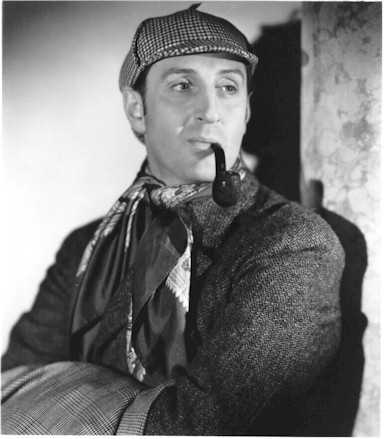
Basil Rathbone as Sherlock Holmes

Basil Rathbone as Sherlock Holmes

Come on, you must have had your suspicions that our Rathbones might be connected to the Basil Rathbone of Sherlock Holmes fame! Indeed it is true Dr Watson!  The Philip Rathbone, of Caroline Greg’s dance card, turns out to be his grandfather.  How fitting that we now have a bonefide detective within our fold. Perhaps he’s been guiding us all along! Sharon

The Liverpool Connection

August 21, 2009 Mary Greg Comments Off on The Liverpool Connection

I hadn’t realised Mary had given quite as many things to Liverpool.  Its great they got back to us so quickly and with such good information.  I wonder if they would be interested in the exhibition?  I can feel a tour coming on – Manchester, Liverpool, Hertfordshire…!! Sharon

The Letters

August 21, 2009 The Letters Comments Off on The Letters
The Letters
Letter from Mary Greg archive

Letter from Mary Greg archive

I’ve recently finished reading the letters and am struck by how much they reveal, both directly and between the lines.  I was delighted to find a lot of unexpected material.  About Manchester – the economic, political and social issues of the day.  About the Art Gallery (the wrangling of the proposed new build and the early developments of Platt, Heaton and Wythenshawe Halls).  About the weather  (I love knowing what the weather was doing on the 23rd November, 1925 “… dense fog prevailing for close on a fortnight…”) and the preoccupation with health (Mary suffered from numerous colds, shingles, chest complaints, influenza and even partial blindness towards the end of her life).

There is plenty to contribute real insight to a profile of Mary. Her progressive thinking and openness to new ideas through references to homeopathy and the Hay Diet.  Her political leanings and views on world affairs from commentary contained in the wartime letters.  And her reasons and passion for collecting of which there are scattered references throughout.  So these letters are a gold mine (I’m convinced there’s a Phd in there somewhere!).

I was particularly struck by the change in tone and flavour of the letters following the untimely death of William Batho (there was a true and genuine warmth there. Believe me!) and how that very sad event also left so many unfinished stories.  Whatever happened to poor Mrs Batho who always seemed to be at deaths door, but who eventually outlived her husband?  And did their daughters ever find suitable careers / husbands?

I’ve also been surprised by how much the letters have influenced my creative practice and thinking.  Partly because I’ve been so engrossed in them I have been distracted from the studio, but equally in how much they’ve instigated ideas, arising not only from my own discoveries but things that others have unearthed too (but more of that at a later date).  I am thoroughly enjoying the archival research and following the trails that are thrown up.  Sharon

The Herkomer Drawing

August 16, 2009 featured, Mary Greg 1 Comment
The Herkomer Drawing
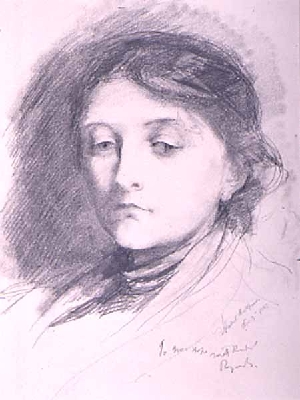
Mary Greg aged 36 by Hubert Herkomer, 1885

Mary Greg aged 36 by Sir Hubert von Herkomer, 1885

Just as Melanie told me she had unearthed a Herkomer drawing of Mary in the archive I came across a reference to it in the letters.  On Sept 11th, 1941 Mary writes about more things she is sending to the Art Gallery including

…”a portrait in pencil – or chalk – of myself by H. Herkomer which Mr Batho asked for.”

The accession number of the portrait matches the date of the letter, so that’s definitely when it came into the collection.

At the time of sending Mary was 91 and beginning to pack up the flat in London as it was getting too much for her (she moves to Cheshire). As the portrait was made when she was 36 It must have been with her for a long time and probably hung somewhere at Coles and the London flat.

The art historians amongst you will already know that Herkomer was a well known and successful artist of his day.  His work can be found in numerous UK collections including the Tate, the National Portrait Gallery and the Royal Academy of Arts, where he was Professor of Painting from 1899 – 1900 and again 1906 – 1909.  His most famous paintings include On Strike (1891 held at the RA) and Hard Times (1885 held at Manchester Art Gallery).

How did Herkomer end up drawing Mary? Interestingly the portrait of Mary is also dated 1885. Is that how he came to draw her, through the Art Gallery connection? Did Thomas Greg commission the portrait of his wife?

There is another possible connection in that Herkomer moved with his second wife to Bushey, Hertfordshire where he built a house about 40 miles from Coles.  Might they have been part of the same social scene?  Did the Gregs put in a good word for him at the Art Gallery and encourage the purchase of the painting?  Or were they not involved with the gallery at this time and the whole thing is just conjecture and coincidence?

I have added the links to Herkomer for those who would like to find out more.  Sharon

http://www.artrenewal.org/asp/database/art.asp?aid=882

http://www.artcyclopedia.com/artists/von_herkomer_sir_hubert.html

Things Sent to Other Collections

I’m now up to 1935 in the letters and have found a few more things to add to the list of objects that Mary contributed to other collections.

She gave a patchwork to Salford and the Mesmer discs (anyone know what these were?) to Liverpool, Jan 23rd 1930.

In a letter dated 7th July, 1930, there is mention of a tobacco box being sent to Fletcher Moss Museum. Probably long since defunct or is it?  Apparently she “turned Mr Sabin (curator, Bethnal Green) away with a taxi nearly full of things…”, in Feb 1930.

Amazingly she also sent some things out to New Zealand (letter, 14th Oct 1931).  She writes

“- just lately we have been sending out pictures and many objects of the past to New Zealand for a museum at Timaru”.

No mention of who or how she is connected to that particular museum, but I wonder what we could find out. Batho’s response is lovely

“How splendid of you after doing all you have for galleries in the old world that you should now tackle galleries in the new world.”

In 1932 (July, 3rd) Mary mentions a small box of things for a Mr Gilbert Williams, curator at Stockport (museum or Art Gallery?).  He is mentioned again in 1933 along with Mr Maltby, curator at Salford. So more things sent then. And in a letter dated 8th July, 1934 there is a list of more things for Stockport including an “Egg boiler with ivory or bone uprights, The Pedlar Lady, small number of kitchen toys, 1 doll (1900 cent) and a travelling ink well” (ooh Hazel an ink well that travelled – where did it go?!).

She also gave more things to the Manchester Museum, two earthenware jars (Cypriot) and a dish (Egyptian) and an Ushabti (whatever that is) in July 8th, 1932.

We already know that Mary gave lots of things to “her Westmill Museum”.  The letters show that there was a catalogue for the Westmill collection ‘The History of Westmill’ by Guy Ewing.  Mary sent a number of these catalogues to Manchester and at least 24 were placed in Manchester branch libraries (including Stretford, Eccles, Walkden and Davyhulme). One was even sent to Cyril Fox, Director of the National Museum of Wales, Cardiff!  It would be fascinating to track one of these down, if they still exist, to see what was included.  We might come across some old friends!  Sharon