Curiosity Shop

September 5, 2009 Mary Greg 3 Comments

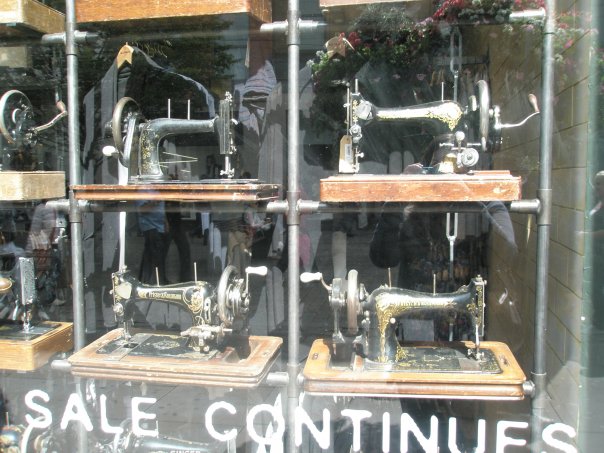
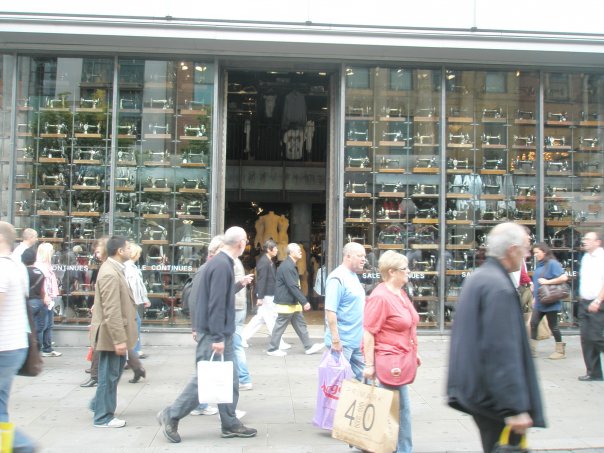
As I was walking through town the other day I was struck by the window display in All Saints. The windows are decorated floor to ceiling with sewing machines. I thought it was a bit Mary Greg-esque and promptly took some photos.

10316_552265670249_223801029_3585570_7944400_n

Sewing Machines

All Saints, Manchester

All Saints, Manchester

 The thing I found most interesting was that people were stopping to look at them much in the same way they would a museum display case, they didn’t go in the shop but were intrigued by its exterior.

Melanie

A Forgery in the British Museum and other Objects

September 3, 2009 Hidden Stories 1 Comment

As well as the pilgrim badges I asked the British Museum to send me a list of Mary’s objects. There are hundreds! Some are given in memory of Thomas Greg and most were accessioned in 1921, with a few from 1919 and 1924.

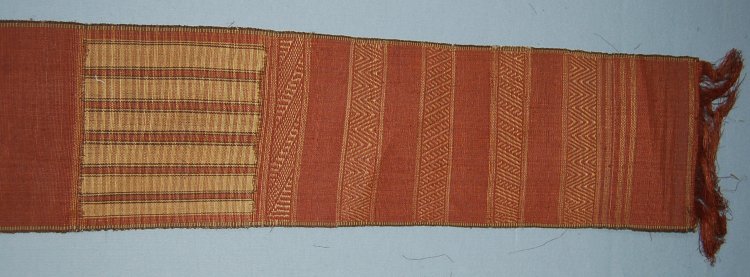
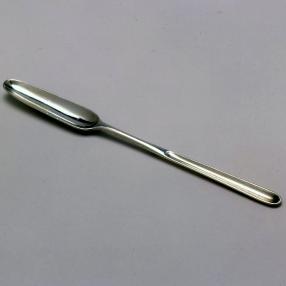
There are 30 badges and pilgrim badges, a host of keys and spoons and some intriguing items, like a fire-steel; an object used to strike a spark for a fire. A marrow spoon; a spoon with a long thin bowl to extract the marrow from bones in the 18th century. Another object is a loin cloth previously thought to be a belt.

Loin Cloth in the British Museum

Loin Cloth in the British Museum

Marrow Spoon used in the 18th Century

Marrow Spoon used in the 18th Century

There are 167 items that were donated by Mary and 2 items that the museum purchased from her. One of them is a forgery, it is a locket from the Shadwell Dock forgeries in the mid 19th century. I looked this up and it was a quite exciting story about two mudlarks who searched the banks of the Thames for items of value; they were called ‘Billy and Charley’, William Smith and Charles Eaton. They would take their finds to William Edwards a London antique dealer who would pay them, however as their finds became fewer they decided to make counterfeit antiquities in 1857. They made moulds and dipped the metal objects into acid to speed up the ageing process and they would make £400 a year. It is an extroadinary story and they were eventually caught for fraud and had a trial (which surprisingly increased the sales of their forgeries) where leading archaeologists of the day such as Thomas Bateman and Henry Syer Cuming challenged them. You can read more about the Billy and Charley forgeries here

A nice bit of scandal!

Melanie

Some Pretty Diagrams

September 1, 2009 Mary Greg, The Letters Comments Off on Some Pretty Diagrams

Family tree of sorts

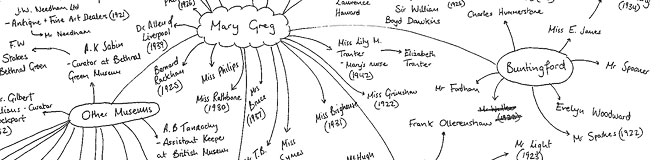
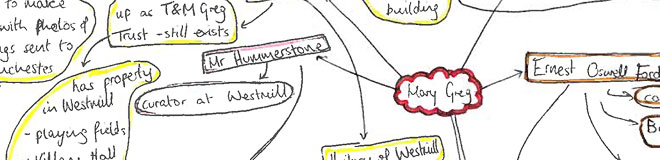
I’ve made a diagram of all the people mentioned in the letters 1920-1949. It’s available as a pdf download below.

Download the Mary Greg Map

Hope Family Tree

And I got to grips with Mary’s family tree too, you can see a pdf version via the download below.

Download the Hope Family Tree

information

Along with the map and family tree there’s some useful information that Alex and I got from Bridget Yates, who came to visit the gallery as she was interested in a postcard of Ashwell Museum for her Phd. on volunteer-run museums. She was really helpful and gave us a bit more of an insight into the people of Buntingford that Mary knew so well. I’m quite attached to the photocopier/pdf. maker (as you can see!) so I thought it would be easiest to collate this info in a diagram, with colours!

Download Information from Bridget Yates

Melanie

Well Travelled Objects and Badges at the British Museum

September 1, 2009 Mary Greg, The Letters Comments Off on Well Travelled Objects and Badges at the British Museum
Well Travelled Objects and Badges at the British Museum

I was quite curious about the journeys of Mary’s objects. Sharon asked me to research ‘five Roman bronze needles found in Lincoln by James Smith of Whitechaple’ mentioned in a list of things sent to Manchester in April 1926. I couldn’t find these in the collection and had assumed they were deaccessioned or disposed of. However in my recent correspondance with Liverpool museums, the note written in 1929 by the Deputy Chief Librarian, ‘Donations by Mrs. M. Greg and Miss Hope’ mentions ‘Roman pins found in London’ I believe these could be the same objects. As there may have been some mistake between Lincoln and London and the man who found them lived in Whitechaple. (I have assumed this to be London as there are no places near Lincoln with the same name.) Although the Roman needles were given to Liverpool they did not keep them as they are not on the list of items in their stores today.

Pilgrim Badge in the British Museum 1921.0216.64 donated by Mary

Pilgrim Badge in the British Museum donated by Mary. (1921.0216.64)

This made me curious as to whether the needles were moved on or disposed of, so I decided to look at a few museum databases and search their collections. The British Museum has 108 results for Roman bronze needles and many of them have no further information other than an acquisition number. An unfortunate dead end perhaps. I typed in Mary Greg to their database anyway to see what I would find… I was pleasantly surprised to find some different objects!

Another item Sharon asked me to research were ‘lead badges found in Tortosa’ that were mentioned in a letter dated 26 October 1924. they were sent to the Fitzwilliam in Cambridge. When I contacted the museum they told me they did have a variety of objects donated by Mrs Greg but not the ones I enquired about. On the British Museum’s database I found that Mary had donated a number of lead pilgrim badges. Although these could not have been the ones mentioned in her letter as these were accessioned in 1921. They are perhaps similar.

The lead badges mentioned in 1924 were found in Tortosa. This was a place involved in the Crusades in Syria – today it is called Tartus. In 1123 the crusaders built a church there called Our Lady of Tortosa which was known for its pilgrims. I think these could be linked.

It is an interesting notion of journeys and pilgrimmages that these objects emit. I think that Mary herself went on journeys with the objects. She met so many interesting people because of them and had contacts in all parts of the country. Her letters are a document of the emotional journeys she went on as well as the physical ones of her objects.

Melanie

Timaru!

August 28, 2009 The Collection 1 Comment

I have so many things to put on the blog that I’ve found; its been a busy week! But I will try and get everything on today.

Anyway, a few weeks ago Sharon mentioned that Mary sent some objects to Timaru, New Zealand. Unfortunately the letters don’t specify where in Timaru so I emailed their local museum, South Canterbury Museum to see if they had ever heard of Mary. My first response was that nothing came up in the database under the name Mary Greg. As the museum was set up in the 1940’s I thought it might be too late for Mary’s objects anyway.

However, I received an email this morning telling me that museum staff believe Mary was a donor to the Hope Collection! Which was donated to the museum in 1954. It belonged to Arthur Hope, Mary’s brother; who moved to New Zealand in 1878. He was a farmer in South Canterbury. The collection has over 200 items. Lots of textiles and other artefacts, including a framed embroidered picture worked in wool, by Mary Hope and Mrs. T. Greg. The collection was exhibited in 2006 and my contact, Davina Davies researched the objects as much as possible but could not find out anything about Mary Greg because she had assumed she had lived in New Zealand.

Davina mentions that some of the objects are rare and unusual and many are in poor condition. I have asked for a catalogue of the exhibition and a picture of Mary’s embroidered picture.

How exciting!

Melanie

Mary Greg, Mr. Sabin and Bethnal Green Museum

I emailed Bethnal Green Museum last week to find out about some of the objects Mary sent and whether they knew much about Mary Greg. I was pleased to find a reply commenting on how important Mary had been to the formation and development of their collections. I was sent an article: Anthony Burton and Caroline Goodfellow, ‘Arthur Sabin, Mrs. Greg and the Queen.’ V&A Album, no.4, 1986 pp.354-366. The article details the objects that Mary sent to Bethnal Green and her involvement with some of the objects creation. Although the article focuses on their curator, Sabin, Mary was an integral part of the success of the Museum of Childhood.

Their story began in 1922…

Mrs. Greg was living at the family property at Coles, Buntingford, Hertfordshire, when she was put in touch with Sabin by ‘a lady known as Sister Frances, who devotes her life to the well-being of the children of East London’. Calling at the museum in December 1922, Mrs. Greg offered to donate a dolls’ house, and Sabin persuaded her to commission for the children an architectural model of a cottage ‘such as would not be beyond their dreams of possessing some day for themselves, furnished beautifully and simply, so as to inspire them and give them a sound ideal for the material side of their home’. This, designed by Charles Spooner FRIBA [Fellow of the Royal Institute of British Architects] was eventually delivered in 1924.

Burton and Goodfellow, p.355

Spooner is mentioned in the letters I thought he was just a friend of Mary’s but he had a far more active role.  This must have been the encouragement that Mary got from making her own objects, such as the shops and the firescreen.
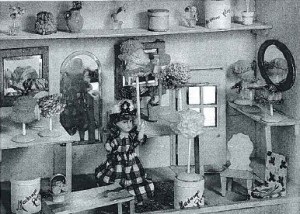
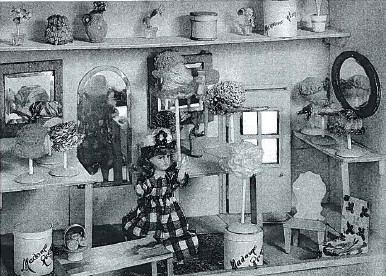
Milliner's shop. Given to Bethnal Green by Mary in 1925

Milliner's shop. Given to Bethnal Green by Mary in 1925

 She gave the shop above along with a greengrocer and a fishmonger and it is thought she had a hand in making them.
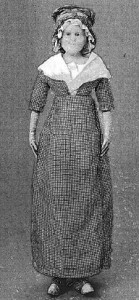
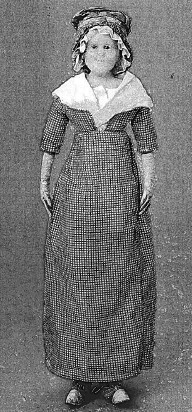
English doll with a solid wax head, representing an old woman. Given by Mary in 1926.

English doll with a solid wax head, representing an old woman. Given by Mary in 1926.

This doll was submitted through the V&A textile department. The head is said to be remarkable because it has the wrinkled face of an old woman, sensitively modelled. It is most unusual for a doll to have the face of an elderly adult, especially an adult who belonged to the lower classes as the dress suggests. Burton and Goodfellow believe it to be ‘a special commission, perhaps a portrait of an actual person – a servant or nanny.’ It was made in the early years of the nineteenth century.

Eventually in 1930, Mary’s donations became less and less and her position as a chief donator for children gave way to Queen Mary who was equally enthralled by dolls and dolls houses. Also at this time, other museums began to pick up on Sabin’s work and the importance of introducing children to museums. This was such a change from the the early years when the things that Mary gave were not considered valuable.

In view of the ultimate destination intended for these interesting, but rather trivial, little toys, I recommend their acceptance.

A.J. Koop, Burton and Goodfellow, p.365

Sabin was very determined in his quest to bring museums to children and wrote in the preface to Mary’s catalogue of Heaton Hall, The Greg Collection of Dolls and Dolls Houses in 1923…

Man cannot live by bread alone; and from the beginning of civilisation, when he made the first domed hut as a needed shelter for his wife and child, he has moved in all his best labour by devotion to others. And in particular those things that have been done for children, the payment of which has been in no earthly coin, embody the noblest qualities of men’s labour, because of the innocence of their motive and the love that inspired them. So in their turn thee children’s things become and inspiration.

Arthur Sabin, Burton and Goodfellow, p.365-6

My  favourite part of the article is quoted below…

A phrase which Sabin must have used to good effect was: ‘the children hungry for beautiful things to look at.’ It was quoted back at him in a letter of 8 July 1923 by one of his principal fairy godmothers, Mrs. T.T. Greg.

Burton and Goodfellow, p.355

I just love the image of Mary Greg as a fairy godmother!

Melanie

Mary’s Links with Liverpool: Samuel Hope

August 26, 2009 Mary Greg 11 Comments

You may remember I mentioned Mary’s grandfather Samuel Hope, who was a prominent banker, after who Hope St. in Liverpool was named. Well I’ve found out a little more about him.

Hope Street was not named after Samuel but his father- Mary’s great-grandfather, William Hope who was a mercer and draper. He was the first to build a house on that street where the Philharmonic now stands. Samuel Hope started a partnership with George Holt called Samuel Hope & Co. They were cotton brokers, however they decided to become bankers as well. In 1823 they dissolved this partnership and the businesses were divided.

Samuel Hope who had originated the cotton business, became banker solely , and George Holt to whom it is said that the initiation of the banking business was due, became cotton broker solely.

John Hughes, Liverpool Banks and Bankers 1760-1837: a history of the circumstances which gave rise to the industry, and the men who founded and developed it, H. Young & Sons, 1906, p.208

Samuel still used the name Hope & Co. with Edward Burrell. They were very wealthy and converted the private bank into a joint-stock company under the title of the Liverpool Borough Bank with a capital of £500,000 in £10 shares. They had lots of support as 32,000 out of the 50,000 shares were appropriated before public issue.

Unfortunately after Samuel died in 1837 the bank went to ruin, when ‘much imprudent business was done.’ This escalated in 1847 because of ‘excessive railway speculations’ unfortunately the Bank of England had to intervene and then ten years later universal distrust in America caused all major banks to panic, this had a knock on effect in England. 

On 27th October 1857 the Borough Bank closed its doors. On examination of affairs it was found that its bad debts were exceedingly large. Some £600,000 to £700,000, previously taken as good, were now found to be almost valueless. They had £3,500,000 bills in London with the endorsement of the bank, and this amount some £700,000 to £1,000,000 “had no negotiable validity at all except that endorsement.” The whole total loss was estimated at £940,000 the whole capital of the bank being thus swept away.

Hughes, pp.213-4

That would be a lot of money lost today, but back then it must have been unfathomable. I wonder if this had an effect on Samuel’s family or whether they divorced themselves from the bank after Samuel had died. John Hughes book, Liverpool Banks and Bankers 1760-1837, also gives an insight into Samuel himself. He lived in Everton after purchasing houses there in 1828 which he knocked down and built a ‘spacious and elegant mansion’. So the Hopes were clearly a respectable and wealthy family. Samuel Hope was described…

To the poor and uneducated he has been, and still continues to be, a fervent, active, and sincere friend.

Syers, History of Everton, Liverpool, 1830 in Hughes, p.207

Hughes describes Samuel as well, I think the likenesses between him and Mary are quite prominent…

He was a man of considerable strength of character, and had pronounced Liberal views. In philanthropic endeavours he was ever to the fore, and he was earnest in his promotion of educational improvement.

Hughes, p.212

It seems he was also quite political and had strong views.

He identified himself strongly with the anti-slavery movement, and was an influential speaker at public meetings… A sturdy Nonconformist Mr. Hope took the chair on two occasions in 1837 when the question of the abolition of church rates occupied public attention.

Hughes, p.212

Sorry lots of information there, but hope you find it interesting!

Melanie

Mary’s links with Liverpool

A while ago Sharon asked me to find out about a dolls house offered to Mr. Arthur G. Quigley, curator at the Liverpool Museum in February 1929. So I emailed National Museums Liverpool and they did indeed take the dolls house, its accession number is 30.112, but before this gift she sent a whole range of items in 1929. Including…

Sarah Thrifty, Pedlar doll; Elizabethan brass spoon; Silver case scissors; Seal and Chatelaine;

Mary did like those chatelaines! There are too many items to list here but I could email it to anyone who is interested. As well as the objects there is a revealing note from the deputy chief librarian…

Mrs. M. Greg is the grand-daughter of Samuel Hope, Banker, of Liverpool – after whom Hope Street is named. She is over 80 years of age, and, as she put it, “I am anxious to do something for the children of my native city.”

The Hope famly must have been a prominent family of the city, no wonder they partied with the Rathbones and married into the Greg’s. I’m going to do a bit more research on Samuel today. The librarian then goes on to describe the dolls house…

The house which Mrs. Greg offers was made by Hummerston, of London. It is about 3’6″ by 2’6″ high, with the front hinged. It is early Victorian in architecture, and the furnishing of the apartments are of the period 1830-50, showing in complete deatail the mode of life of its inhabitants.

I can’t find a Hummerston’s of London but perhaps it has something to do with Mr Hummerstone of Westmill? He also mentions that Miss Hope, Mary’s sister gives objects to the museum…

Miss Hope, who lives in the same block of flats as Mrs. Greg, offers a model of a Swiss Kitchen – an excellent exhibit, in a glass case about 15″ square.

Deputy Chief Librarian, Donations by Mrs. M. Greg and Miss Hope, 6th June, 1929

Melanie

Mesmer Discs

August 18, 2009 The Letters Comments Off on Mesmer Discs

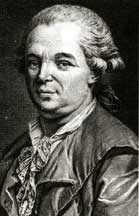
I couldn’t find out what these were exactly. But I’m pretty certain they have something to do with Franz Mesmer (1734-1814). He was an eighteenth century physician that discovered animal magnetism, natural magnetism in the body. He would use magnets on patients to cure their illnesses which he believed were mostly in the mind. His theories played a large part in the development of hypnotherapy; which was first called ‘Mesmerism’ and is where we get the verb ‘mesmerise’ from.

Franz Anton Mesmer (1734-1814)

Franz Anton Mesmer (1734-1814)

I believe the discs Mary mentions are magnets used to control the natural animal magnetism in the body. Mesmerism had many critics like hypnotism does today but in her letters Mary is always praising alternative treatments (as well as a brief stop at Colwyn Bay). She was a fan of the Hay diet…

How I wish all invalids could throw off all doctors & try the very simplest way of eating!! You will perhaps have heard of  of the wonderful new discovery by an American doctor Hay by name – he says we eat the wrong mixtures and though we still eat the same food to a certain extent – we must not mix them – The results are wonderful.

Mary Greg, 23rd November 1936

She also promotes homeopathy…

I was very sorry that your eyes gave you trouble some time ago – have you tried homeopathy for them? It is so safe & wise in its treatment & help ones constitution so wonderfully.

Mary Greg to Dr. Tylecote, 9th January 1939

As Mary lived a remarkable long time in quite good health I think there’s something to be said for these alternatives!

Melanie

Mr Batho.

August 14, 2009 The Letters 1 Comment

In the archives I found a whole article on him. It seems he was a much loved character around the gallery.

It please me to write about Mr. William Batho – because Mr. William Batho pleases me. It is always a relief and a pleasure to go to Mosley Street and talk to him; he is ‘one of the best’ to a Pressman, I think, for he is usually both sympathetic and helpful.

The Watchman, ‘Looking after the Art gallery’ City News, 29.8.1931

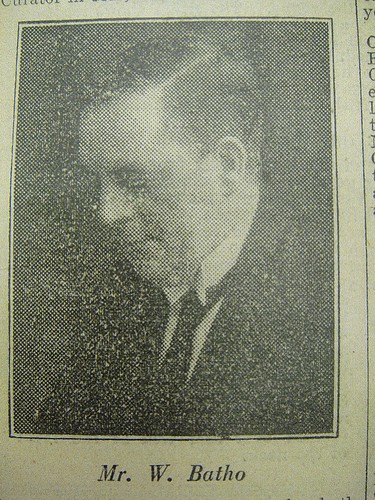
Here is the man himself…

Mr. William Batho

Mr. William Batho

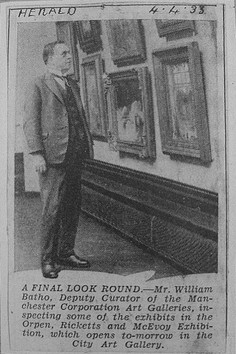
I think he seems camera shy! Here he is in action around the gallery…

Mr. Batho supervising paintings being unpacked for an upcoming exhibition

Mr. Batho supervising paintings being unpacked for an upcoming exhibition

Mr. Batho admiring the new exhibition

Mr. Batho admiring the new exhibition

Melanie